
Entrepreneurship can be extreme. Bouncing from wild emotion to wild emotion, it can feel difficult to find inner peace. Living exposed to the extremes can contribute to a sense of burnout that is, unfortunately, quite common for entrepreneurs. As a founder, I've often wondered how I can find my emotional footing, a sense of balance amid a busy and chaotic life.
One day I came across the Tao Te Ching. Written in China around 400 BC, the book is short and timeless. With a deceptively simple format, the Tao Te Ching is in fact pretty deep; it explores ideas that are just as relevant for us today as they were for people two and a half millennia ago.
What is Tao?
The concept of "Tao," which is the foundation for the Taoist tradition, translates to "the way" or "the path." The Tao can be interpreted in many ways. One interpretation is the Tao as the natural order of the universe. Taoism teaches that extreme thinking runs counter to the natural harmony of the universe. By following the natural flow of things—nurturing equanimity, and taking effortless action with deep intentions, you can live with a greater sense of harmony between your inner reality and the world you exist in.
To me, the Tao holds a solution to the extremes of entrepreneurial life. It points the way to a grounded and resilient mindset. The Tao Te Ching is old: over two thousand years ago, humans were struggling with the same inner conflicts as we do today. The search for inner peace and balance is a timeless, universal theme.
I wrote Tao of Founders inspired by the ideas within the Tao Te Ching, and with a clear audience in mind: entrepreneurs. This book is about mindset more than occupation. To me, being an entrepreneur is a mindset, a creative way of being. Founders are not a defined by their job title. Not everyone is an entrepreneur, but everyone can be entrepreneurial. I wrote this book for those who want to better understand and approach the inner aspects of entrepreneurship, for those seeking resilience, all while navigating a generally chaotic and challenging life.
Duality and the founder's journey
As a founder, you are writing your own version of the classic hero's journey¹: you face a series of challenges that show up in various ways through the physical (outer) and the emotional (inner) aspects of your lived reality. The founder journey resembles the arc of the hero's journey, as outlined below.
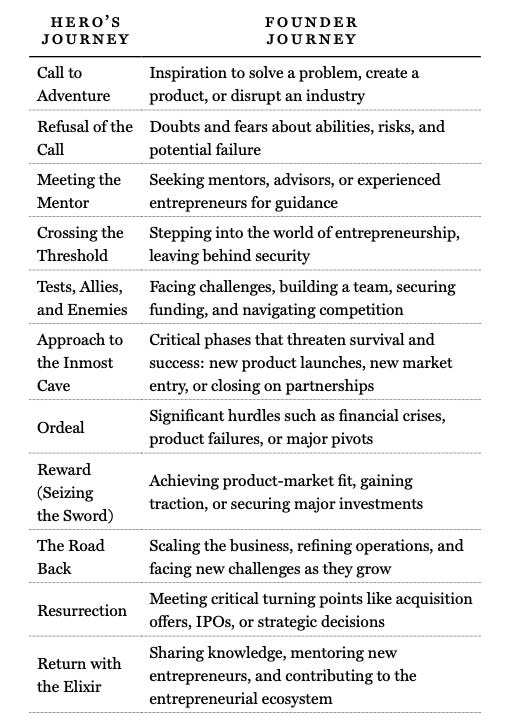
As you progress on your journey, your external problems and your emotional landscape may appear unrelated to each other, like black and white, but in fact they arise together. In Buddhist terms, the object (your reality) and the subject (your mind) are said to "co-arise," since nothing exists independently.²
There are no fixed separations between your inner and outer worlds. Labeling your issues as inside vs. outside challenges introduces a dualistic perspective. The thing is, duality is a human invention. All things you label as a problem arise only from one place: your mind. Taoist traditions understand the non-dualistic nature of life and reality. Embracing a non-dualistic view means that you don't need to choose between A and B, even when they appear opposed, like the yin and the yang. Yin and yang form a whole, a circle.
In the same vein, a sense of balance, or inner peace, is sometimes easier to achieve when opposites are paired together.
A non-dual mindset might help you feel less exposed by moving away from the extremes, by not believing in them. Working on being more centered brings you clarity, consistency, and momentum. These qualities will guide you as you advance on your own founder journey.
Why talk about duality in entrepreneurship?
Entrepreneurship is full of paradoxes: they will test the founder at various stages of their journey. By handling the paradoxes well, founders gain the opportunity to move closer to their potential. Paradoxes make you believe your reality is black or white when in fact it is black and white—and all the hues of gray in between. The thing is that a paradox, by definition, cannot be solved. So quit trying. The only real way to solve a paradox is through seeking a different frame of mind and being comfortable with ambiguity—moving past duality.
We'll look into many entrepreneurial paradoxes throughout this book. Each chapter in Tao of Founders is an exploration of distinct and timeless insights that can help founders embrace some of the most common paradoxes you encounter as a founder. For example:
You hold unwavering faith in ultimate success, while confronting the brutal and humbling facts of your current reality.
You rely on the help of others to reach your dreams, while trying to not care too deeply about what they think of you.
You are a human being not a human doing.
Your founder journey is about overcoming yourself
At the core of every hero's journey, the hero's inner realm evolves directly in relation to the external problems that call them to push through their limits. The hero overcomes problems by overcoming themselves. By focusing inward, the hero is equipped to better handle reality and all its challenges. I believe that the most common (and least discussed) obstacles for startup growth are the founder's emotional ability to see clearly and face what is needed of them.
By learning to better approach your problems from an inner perspective, you equip yourself with better tools to tackle all of your challenges, and by extension, to help your employees and colleagues tackle their own problems. It all starts within. Your challenges and your difficult emotions are road signs showing you the way to a better version of yourself—if you lean into them.
Why I wrote this book
As I said, when I first became a founder, my emotions felt extreme for the entire ride, from start to exit. I often couldn't tell how I felt because I felt euphoria and terror at the same time.
The emotional roller coaster did not stop when we sold our startup. When the company I co-founded, Return Magic, was acquired by Shopify, I had to navigate a new set of emotional and motivational challenges. Now an employee, I lost some of the independence I valued. I had to redefine my purpose, my work identity. I really wanted to be accepted and respected by a bunch of brilliant colleagues, and I wanted to prove that we were worth acquiring in the first place—that we were worth taking a bet on. Proving my worth and fueling my ego caused me to build emotional debt; I repressed emotions that I was unwilling or unable to fully experience. Instead of dealing with my emotions to let them go, I built up invisible weight on me that pulled my mind down. didn't have enough time or energy to really care deeply about anything. I felt like a dimmed version of myself. A lifetime of unmanaged thoughts and emotions had built up, and all of it was boiling over now.
On the outside, it appeared like I had found success. I was ticking some of those traditional "success" boxes, yet I felt mostly numb. Chronic stress turned to depression. I didn't want others to see me struggle, which led me to hide my emotions even deeper.
About six months after being acquired, bearing the weight of my fossilized identity, I kept wondering why I felt bad all the time. Fortunately, with the help of an executive coach and therapist, I worked on reframing how I view and talk to myself. These coaching sessions were the start of a series of insights that would culminate with the book you are reading right now. I hadn't planned to share these personal lessons, but I felt compelled to offer my fellow founders a few insights I learned the hard way.
The reason I bring up some of my issues here is because all founders experience their own flavor of struggle, whether it shows or not, whether they admit it or not, and whether they know it or not. As a founder, you're playing life on hard mode, but that doesn't mean you should struggle alone. Sharing openly invites others to do the same.
Chances are the big problem you have today is nothing new. Other founders have likely experienced it and have already found effective ways to overcome similar challenges. You are not alone. Exposing what makes you vulnerable may feel uncomfortable, but sharing your challenges is what enables other founders to relate to you. It's a small price to pay for the potentially life-changing upside that comes from tapping into collective wisdom.
When things feel especially hard, it helps me to remember it's not all on my shoulders. I can always lean on the wisdom of those who have come before me, or seek the advice of a peer. Somehow, all of our individual hero journeys are intertwined.
The reward a founder gets for solving problems is bigger problems to solve. Sooner or later some problems will feel overwhelming to you. I hope this book serves as your emotional survival kit when you experience the challenging feelings that are part of the entrepreneurial course.
Now let's get to it.
We are human beings, not human doings.
—Adrian Howell