
As the founder of Polaroid and inventor of instant photography, Land wasn't just a brilliant scientist—he was a visionary who embodied a rare fusion of scientific genius, artistic sensitivity, and philosophical depth. Like many top founders, Land was someone comfortable with embracing opposites, ambiguity and contradiction.
With over 500 patents to his name, Land's mindset on innovation and leadership offers timeless lessons on what makes a great founder, well great.
In Their Own Words: Edwin Land
Land's mind worked differently from most. At 17, he dropped out of Harvard after becoming obsessed with polarization of light, later recalling, "I could see the multiple reflections between the images in the darkening glass. I could see the molecules. I could see the whole thing." This moment showcases Land's extraordinary capacity for mental visualization—an ability to see entire complex systems in his mind before building them—that would define his approach to invention throughout his life.
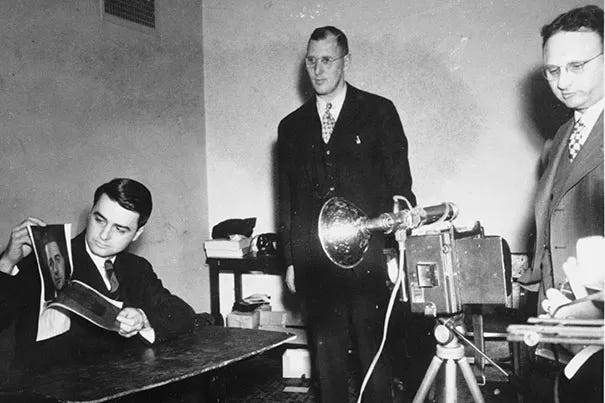
Edwin Land demonstrating the SX-70 camera, one of his revolutionary inventions.
Embrace opposing views
"You need the technical capability, but you need more of the artistic, the poetic, and the nature of vision."
Unlike most inventors who leaned toward either science or art, Land deliberately cultivated both simultaneously. He studied chemistry and art history at Harvard and insisted that scientists at Polaroid also study Renaissance art. Land's creativity reminds us that entrepreneurial wisdom often emerges from the courage to move beyond duality rather than choosing sides.
Focus as the ultimate superpower
"My whole life has been spent trying to teach people that intense concentration for hour after hour can bring out in people resources they didn't know they had."
Land possessed an almost supernatural capacity for focused work. During critical development phases, colleagues reported he would work for 72 hours straight while maintaining peak cognitive function (please don't try this at home). More importantly, he modelled a behaviour that led his employees to also behave with extreme focus, leading to an excellence-driven organisation. As we've seen in the Tao of Founders, the theme is clear: deep focus is always under-appreciated, still the best founders all have this supernatural ability to ignore everything that is non-essential.
Dream wildly, build carefully
"You always start with a fantasy. Part of the fantasy technique is to visualize something as perfect. Then with the experiments you work back from the fantasy to reality, hacking away at the components."
When I worked at Amazon, a core tenet was to "work backwards", by starting with the end in mind (i.e. the complete and ideal customer experience). It worked amazingly well because it lets you clearly visualize what you want to happen and because it helps you track overtime if you're moving closer or further to your end goal. I now suspect Jeff Bezos took a page from Land's book; I wouldn't be surprised since Bezos is known to have deeply studied previous generations of founders.
Humans buy into stories and emotions, not logic
"I didn't just want to explain how it worked. I wanted them to feel what it meant."
Land understood that innovation required not just intellectual but emotional transmission. He meticulously staged product demonstrations as theatrical events, transforming technical presentations into emotional experiences.
5. Diversity + Inclusivity = Creativity
"I don't hire people to tell me what to do; I hire people to tell me what they're going to do."
Land created a unique organizational structure within Polaroid, installing a small, independent team that operated outside normal corporate constraints. His unorthodox approach to talent—once hiring a poet with no scientific background to work on technical problems. According to Land, innovation requires breaking conventional organizational patterns and creating environments and social systems where people can maximize their unique potential.
6. The point never is invention itself
"We are not making a product; we are making a tool that people use to create something that will become a significant part of their lives."
When an executive questioned Land's excessive attention to aesthetics, his response revealed his deeper understanding of what technology means to humans. Land understood that the goal was to solve a need - not invention itself. This is why Land and Polaroid were so admired - he created with a deep sense of purpose, and intentionality, something Steve Jobs took from Land.
7. (Good) questions matter more than the answers
"A problem adequately stated is a problem well on its way to being solved."
Land believed that the proper framing of a problem was the critical first step in innovation. He had a methodical approach to solving seemingly impossible problems:
"If you sense a deep human need, then you go back to all the basic science. If there is some missing, then you try to do more basic science and applied science until you get it. So you make the system to fulfill that need, rather than starting the other way around, where you have something and wonder what to do with it."
This discipline of starting with universal human needs rather than technological possibility ensured that Polaroid was focusing on the important questions (what people want and why), and tackling the questions in the right manner (how can we solve those needs with our unique skills/resources?).
Have a great week ahead! ✌🏼