
In the early 1950s, Ingvar Kamprad’s small mail-order furniture company had grown enough to annoy the established Swedish makers, who pressured suppliers to stop selling to him and barred him from the industry trade fairs. Most people would fight to get back in. Kamprad did not try to solve the issue. Locked out of buying other people’s furniture, he started designing his own. The ban that was meant to end him handed him a distinct style, control of his own line, and eventually a moat no competitor could copy.
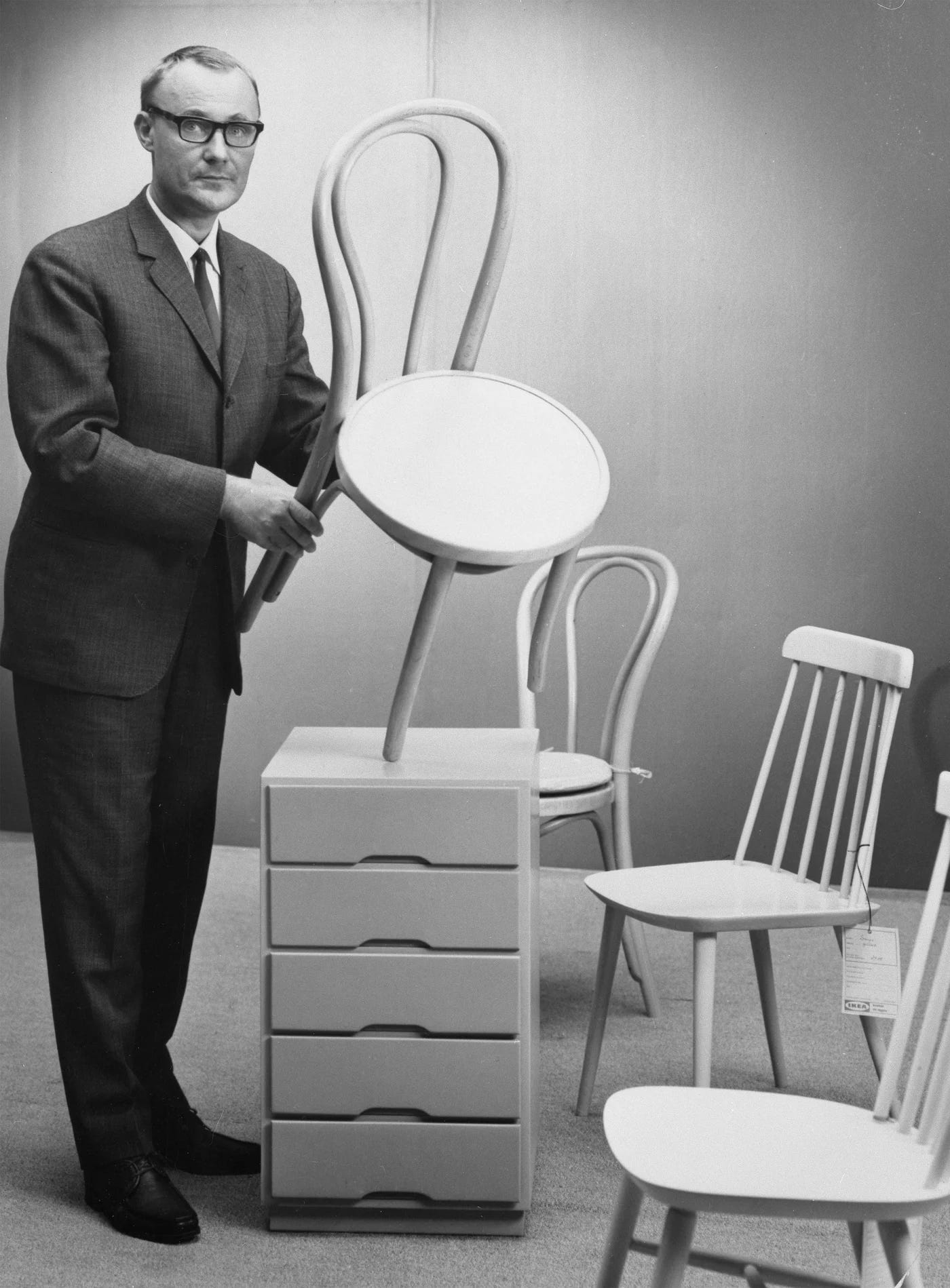
Here is the thing most of us were trained to miss. The leverage in that story was never in how well Kamprad solved his problem. It was in which problem he decided he had. That quiet, upstream act of choosing and reframing the question itself is the part of creative work culture that gets forgotten about.
Founders are trained, selected, and rewarded to be solvers. Faster answers, cleaner execution, tighter loops. Your nervous system loves it, because solving feels like progress in a way that sitting with a half-formed question never does. But the research on where original work comes from points one step earlier. In the 1960s, Jacob Getzels and Mihaly Csikszentmihalyi watched art students set up a still life before drawing it.
The ones whose work was later judged most original were not the better draftsmen. They were the ones who spent longer fiddling with the problem itself — handling more of the objects, rearranging them, refusing to settle on what they were even drawing until late. The researchers called this problem-finding rather than problem-solving.
And the striking part is that early tendency predicted which students were still doing serious creative work years into their careers. The win was upstream, in the formulation, and it stayed predictive for a lifetime.
Einstein had said as much decades before anyone measured it: the formulation of a problem is often more essential than its solution. Leonardo da Vinci worked the same way. He sketched flying machines centuries before powered flight — not to ship an invention, but because the question itself gripped him: how does flight actually work?
Malcolm McLean is also a great example of why asking great questions can be better than solving the existing ones. McLean ran a trucking company, and like everyone in mid-century freight he stared at the problem the shipping industry had been solving for centuries: how do you load and unload a ship faster. Gangs of longshoremen, cranes, days in port — the whole industry sprinting to solve a problem they had all agreed was the problem.
McLean, an outsider, did not solve it. He refused it. The question, he decided, was not how to load the ship faster — it was how to not load it at all. Put the cargo in a standard box at the factory, move the box, never touch the contents until it arrives. Containers were not new; they had existed in crude forms for decades. What McLean found was not an invention but a problem worth building a system around. He reframed “move the goods” into “move the box,” and the reframe — not any clever hardware — reorganized global trade. People, the old line goes, do not want a drill; they want a hole. The whole industry was selling drills.
So why is it so hard to “think outside the box”? Why do brilliant people sprint toward problems nobody stops to question? Because the fluency that makes you good at solving is what blinds you to the reframe.
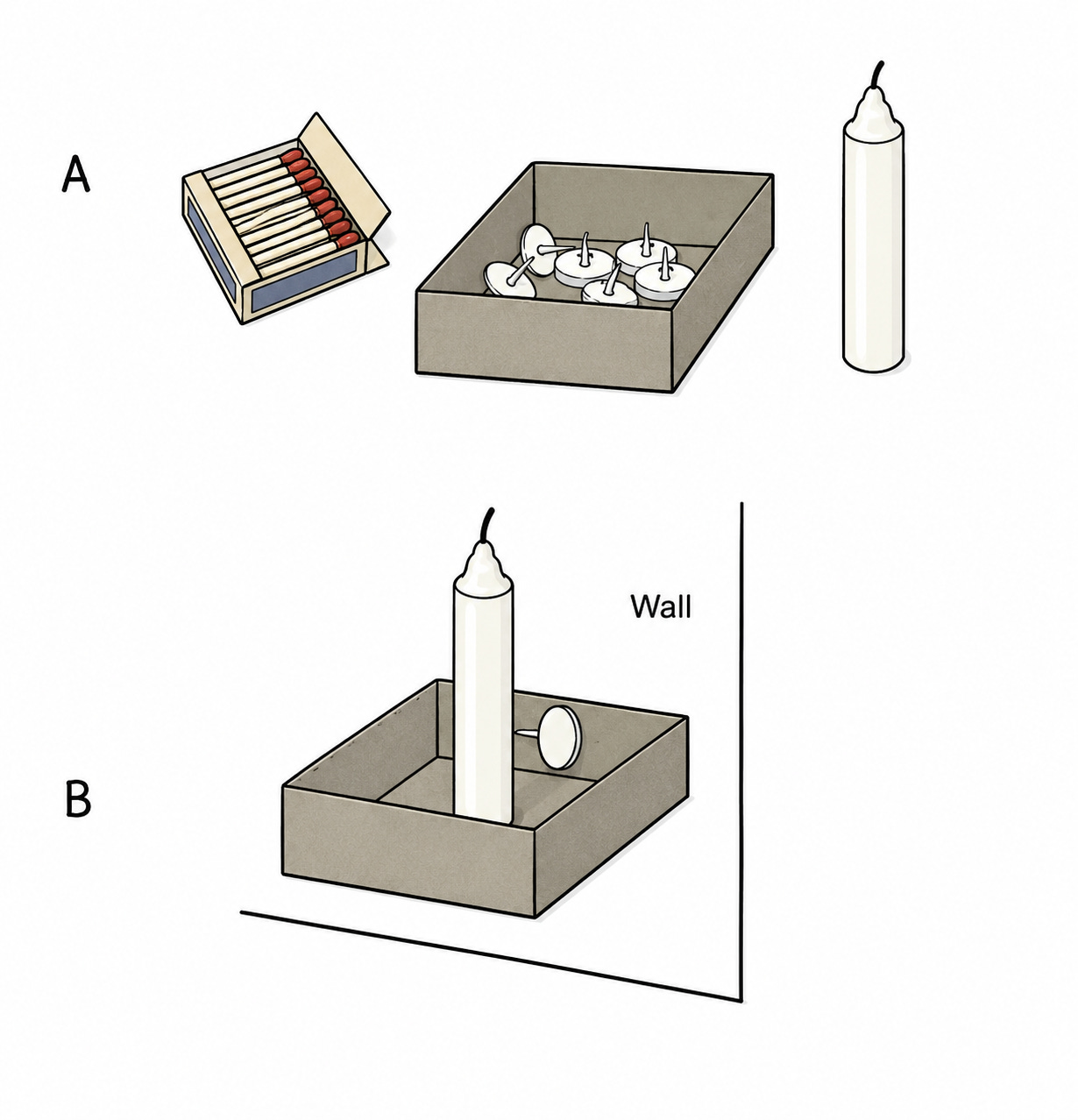
Karl Duncker illustrated this human bias with the candle problem in 1945: hand someone a candle, a box of tacks, and matches, and ask them to fix the candle to the wall. Most fail, because they see the box as a container for tacks and cannot see it as the shelf the solution requires. Duncker called it functional fixedness — the inability to see a thing as anything other than what it usually is for.
Abraham Luchins showed the trap from the other side in 1942. He had people solve a run of water-jar puzzles with one reliable formula, then slipped in a problem with a far simpler answer in plain sight. The trained group kept grinding through the long formula; a fresh control group saw the easy answer at once. He called it Einstellung — the rut a previously successful method carves into your thinking.
Notice what both effects are: the residue of competence. The expert solves fast precisely because their mind has pre-committed to what the objects are and what the method is, and that pre-commitment is what hides the better problem underneath. A solving orientation is a machine for closing the option space. Problem-finding requires holding it open, and the more skilled you are, the more your fluency fights you on it.
“You can tell whether a [person] is clever by his answers. You can tell whether a [person] is wise by his questions.” — Naguib Mahfouz
Expertise is pattern-matching, and pattern-matching is, structurally, the narrowing of what you can see. The beginner’s mind — shoshin — is a technique for debiasing yourself against your own competence — what you think you know — for re-opening a question your skill has quietly closed.
The Taoist tradition goes one step deeper, underneath the question. They call it pu, the uncarved block — the wood before the carver has decided what it will become. The moment you name the problem, you carve the block; you collapse a field of possibilities into one shape, and everything you build after inherits it. A solver’s instinct is to carve fast, because an uncarved block looks like indecision. But the creative power lives in the interval before the cut — in how long you can stand to hold the thing undefined before the block becomes a chair and can never be anything else again.
Kamprad’s flat-pack came from the same refusal to carve early. The story goes that an employee, struggling to fit a table into a car, pulled the legs off — and Kamprad, instead of treating transport damage as a packaging problem, asked whether the customer might assemble the thing themselves.
Problem disguised as opportunity.
None of this means execution stops mattering. McLean still had to build the ports and the ships; Kamprad still had to make furniture people wanted. The answer always has to come. But founder culture has the ratio backwards. You will rarely out-execute a well-funded room of competent solvers. You can out-frame them, because almost no one is trying. Startups win by out-framing incumbents more often than by out-executing them.
The next time you feel the pull to lock the problem and start solving — to carve the block — sit in the question longer than feels comfortable. The urge to resolve the ambiguity is your fluency closing the space before you have looked at all of it. Hold it open one beat past the point where your competence wants to act. So much leverage for founders is hiding in that beat.
“In the beginner’s mind there are many possibilities, but in the expert’s mind there are few.” — Shunryu Suzuki
Sources
IKEA boycott and forced in-house design — IKEA Museum, “Price wars”
Getzels & Csikszentmihalyi, still-life study — The Creative Vision: A Longitudinal Study of Problem Finding in Art (Wiley, 1976)
Einstein & Infeld, The Evolution of Physics (1938), p. 92
Leonardo’s flying-machine studies — Smithsonian National Air and Space Museum
Malcolm McLean and containerization — Harvard Business School, “The Truck Driver Who Reinvented Shipping”
Duncker, K. (1945). On Problem-Solving. Psychological Monographs, 58(5) — doi:10.1037/h0093599
Luchins, A. S. (1942). Mechanization in Problem Solving: The Effect of Einstellung. Psychological Monographs, 54(6) — doi:10.1037/h0093502
Mahfouz quote — Wikiquote
Suzuki, S. (1970). Zen Mind, Beginner’s Mind — San Francisco Zen Center