
“The Best Founders Have Zero Introspection.” Marc Andreessen’s words came out of a thought-provoking interview with David Senra of the Founders Podcast, discussing the mental quirks and habits of the very best entrepreneurs, according to Marc’s own experience working and partnering with those very entrepreneurs at a16z.
That statement about introspection made me pause. I had to wonder, what is he really saying? And how does he even define introspection? No specific framing was given in the interview, so the very concept remains open to your own interpretations.
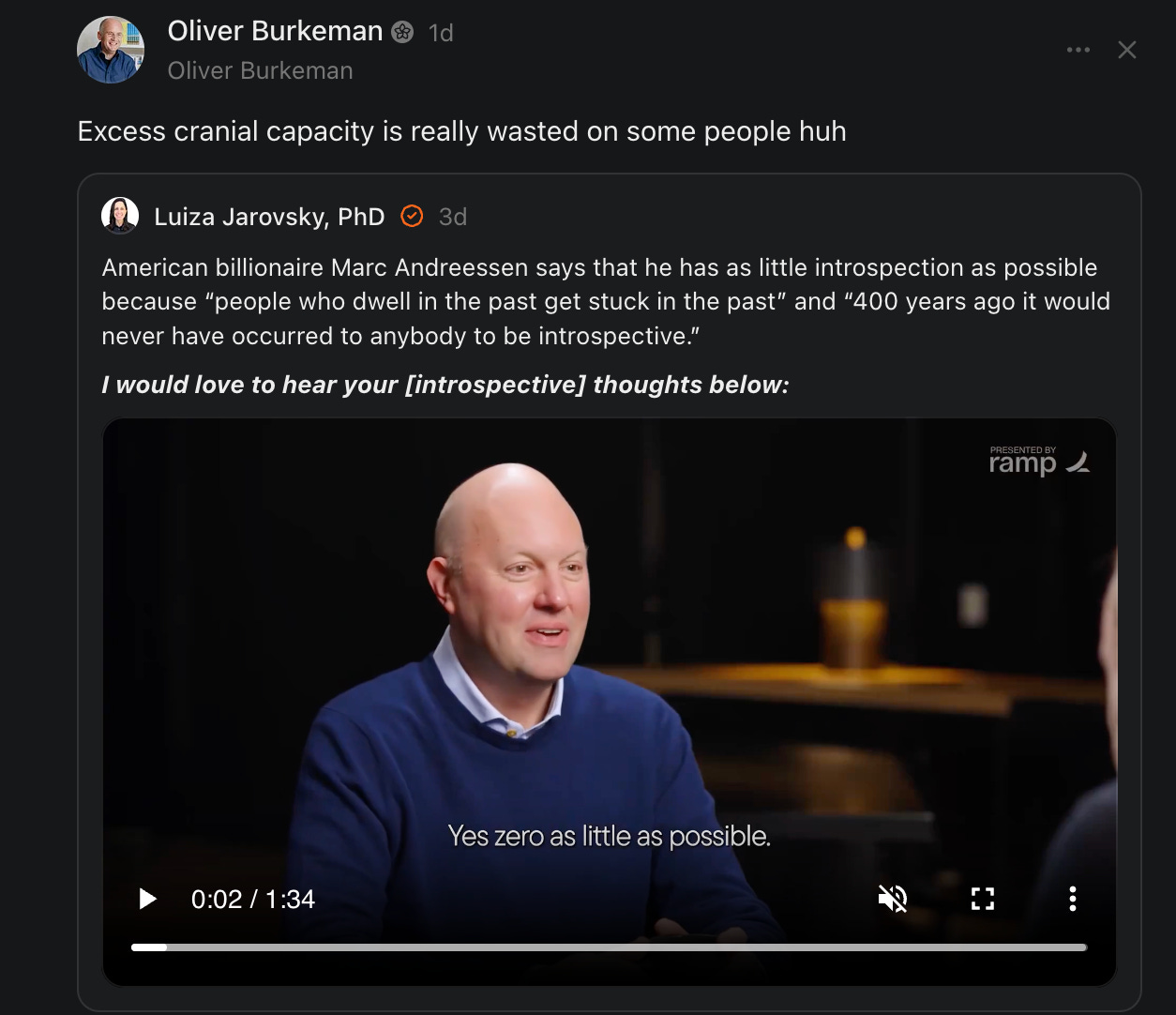
At the core, the question to ask is an interesting one for this week’s post:
What role and value introspection actually plays in entrepreneurial psychology? And how can introspection backfire on you - in terms of your inner life as a founder: feeling happy, creative, effective and impactful.
Here’s my own interpretation of what Marc means by ‘zero introspection’:
the best founders have just relentless forward motion, this non-stop bias for action. They don’t feel a need to slow down, to reflect deeply on their meaning in life - it’s so painfully evident that their answer lies outside of them, not deep within on the other side of a psychedelic trip. Their purpose is their calling and the existential crisis questions don’t even arise for them given how deeply their motivations burn.
How is introspection different than self-awareness and meta-cognition? Clearly founders are learning machines and so they have to be clear on where they stand and what is required to get to the next stage. Great founders have great self clarity - and that is a useful form of introspection: What works, what doesn’t, what skills to build, what lands well with others, etc.
Executive coaches, leadership retreats, journaling protocols, meditation apps, founder therapy -- all built on the premise that looking inward drives better performance. Billions of dollars circulate around the idea that self-awareness is a competitive advantage and what makes leaders their most effective, best selves.
The introspection paradox is not whether to look inward to find answers, you will. It’s whether you can trust what you find there.
Introspection: the examination or observation of one’s own mental and emotional processes.
Self-Awareness: conscious knowledge of one’s own character, feelings, motives, and desires, including an understanding of how one is perceived by others
Meta-Cognition: awareness and understanding of one’s own thought processes.
The Confabulation Problem
You Don’t Know Why You Do What You Do
In 1977, Richard Nisbett and Timothy Wilson laid out four identical pairs of stockings and asked shoppers to pick their favorite. Position mattered enormously -- people overwhelmingly preferred the pair on the far right. When asked why, every participant gave a confident, detailed explanation. The texture was softer. The color was richer. The knit was tighter.
None of it was true. The stockings were identical. Their brains invented a plausible, coherent, completely fabricated story.
We do not introspect. We confabulate.
Nisbett and Wilson’s conclusion was stark: we have no direct access to our own cognitive processes. What feels like introspection is a post-hoc narrative our brains generate to explain decisions already made by mechanisms we can’t observe. Nick Chater took this further in 2018: “The mind is flat. There are no hidden depths.” The authentic self founders are told to discover -- buried beneath the noise, waiting to be excavated through journaling and breathwork -- may not exist at all.
The Bias Blind Spot
Emily Pronin and Matthew Kugler showed in 2007 that introspection itself fuels the bias blind spot. Looking inward doesn’t reduce bias -- it increases your confidence that you’re unbiased. You examine your reasoning, find it logical (because your brain constructed it to feel logical), and conclude you’re being objective. The person who says “I’ve really thought about this” may be the person you should trust least.
Tasha Eurich’s research drives the nail deeper. After surveying thousands, she found only 10-15% are genuinely self-aware. But the unsettling finding: time spent reflecting does not correlate with self-awareness. At all. The founder who journals every morning, does quarterly retrospectives, has a therapist and a coach and a meditation practice -- that founder may have nothing more than a more elaborate confabulation. A richer fiction. A higher-resolution lie.
“We are all strangers to ourselves. We think we know our own minds, but that is a reassuring fiction.”
— Nick Chater, The Mind is Flat
What Andreessen Is Actually Seeing
Andreessen observes something seemingly real. The founders who “don’t introspect” by analyzing too deeply their inner processes may be avoiding a broken tool. They’ve learned -- probably without knowing the science -- that sitting with their thoughts produces noise, not signal.
The Neural Trap
Same Hardware, Different Programs
In 2015, Hamilton and colleagues found that self-reflection and depression activate overlapping regions of the Default Mode Network -- the brain’s “idle” circuit that fires when you think about yourself, your past, your future. No neurological firewall separates productive self-examination from the recursive self-focused thinking that characterizes clinical depression. The only difference is which program runs -- and you don’t always choose.
Trapnell and Campbell identified this in 1999. Two constructs -- rumination and reflection -- produce opposite outcomes. Reflection correlates with openness and growth. Rumination correlates with anxiety and paralysis. From the outside, they look identical. Same posture. Same brain regions. Different programs on the same processor. The person running the program often can’t tell which one they’re in until the damage is done.
Verbal Overshadowing
Jonathan Schooler’s research on verbal overshadowing revealed that putting intuitive knowledge into words degrades the knowledge. In his original 1990 study, participants who verbally described a face they’d seen became significantly worse at identifying it afterward. Melcher and Schooler (1996) extended this to taste -- wine drinkers who described a wine’s qualities became worse at recognizing it. The verbal description overwrote the richer, non-verbal representation. Beilock and Carr (2001) found the same pattern in skilled performance: conscious monitoring of expert behavior destroys the behavior. That’s why top Olympic athletes aim to approach the most decisive moments of their sports lives by just having fun and enjoying the ride - to avoid freezing up physically due to overly analytical processes.
The instinct to “think through” a decision you intuitively understand -- to articulate your reasoning, make it legible -- may actively degrade the decision. Counterintuitively, that’s why trusting your gut is key, especially in stressful, high-stakes moments.
Breines and Chen (2012) challenge another common entrepreneurial myth: that self-criticism drives improvement. Self-compassion -- not self-criticism -- produced greater motivation to change after failure. The “I need to be harder on myself” narrative is empirically counterproductive. You learn by treating yourself the way you’d treat a founder you respect who brought you the same problem.
The Expert’s Trap
Experience Makes Bias Worse
The “just get more reps” crowd needs to sit down. Hmieleski and Baron’s 2009 study found that experienced founders are more harmed by optimism bias than novices. Not less. More. Experience doesn’t sand down your biases -- it gives them texture and detail, lets them masquerade as pattern recognition. The veteran who says “I’ve seen this before” may be matching a pattern that doesn’t apply, but their confidence makes the mismatch invisible.
Gollwitzer showed why. The moment you truly commit to a venture -- money, reputation, identity on the line -- your brain shifts into an “implemental mindset.” A cognitive filter designed for execution, not evaluation. Disconfirming evidence gets suppressed. Confirming evidence gets amplified. Not a choice. Architecture.
The Failure Learning Paradox
Silicon Valley’s favorite mythology -- “fail fast, learn fast” -- runs headfirst into Ucbasaran and colleagues’ 2011 finding: serial entrepreneurs do not learn from failure. The founders who actually extracted learning were portfolio entrepreneurs running multiple ventures simultaneously, comparing outcomes across contexts. Seems obvious: without a baseline you can’t tell what is luck or skill - and how generalizable the lesson really is.
The broader literature on situated learning suggests that reflection on failure only produces learning within the same domain -- switch industries, and the lessons don’t transfer. Shepherd’s 2003 work explains part of why -- business failure causes genuine grief, with the same cognitive impairment and inability to learn that characterizes bereavement. The window when you most need to learn from failure is precisely when you’re least equipped to.
As a thought experiment, if truly introspection, self-criticism, and failure don’t help you, then what actually does?
The Entanglement Trap
Solomon’s Paradox
In 2014, Igor Grossmann and Ethan Kross studied how people reason more wisely about other people’s problems than their own. They called this phenomenon Solomon’s Paradox, after the king renowned for wisdom about everyone’s life except his own.
The mechanism: when you think about someone else’s situation, self-referential processing decreases. The freed cognitive resources produce measurably better reasoning -- more perspectives considered, more uncertainty acknowledged, more conflicting information integrated. A simple intervention -- thinking about your own problem from a third-person perspective -- restored the same quality of reasoning.
“What would I tell a founder who came to me with this exact situation?” is not a cliche. It’s a cognitive technology. It bypasses the confabulation engine by changing the brain’s mode of self-reference. The advice you’d give someone else about your problem is almost always better than what you give yourself -- because your brain processes it through different circuitry.
This reminds me of a passage in Only The Paranoid Survive, where the Intel team imagined they were fired and replaced by brand new management to think freely about what’s needed for solving the challenge at hand.
Ask What, Not Why
Eurich’s work contains a second deceptively simple finding. The word “why” triggers confabulation. The word “what” produces insight.
“Why did my startup fail?” sends the brain searching for a coherent narrative. It will find one. It will be wrong. It will feel completely true.
“What patterns do I notice across my last three decisions?” activates an entirely different mode -- observational rather than explanatory, collecting data rather than constructing stories. One word. Completely different cognitive operation.
Similarly, you’ll learn so much more valuable, actionable insights from customers if you asked them “what would make our product a 10 for you?” instead of asking them why they like/dislike your product.
Reframing Introspection
What Andreessen Gets Right
Identity-level introspection -- the “Who am I really?” variety -- can reduce entrepreneurial action. Montiel Campos’s 2019 study in the Journal of Small Business Management found mindfulness practices actually decreased initiative in novice founders. Flow states require the prefrontal cortex’s self-monitoring to go quiet -- as Csikszentmihalyi and Dietrich showed, self-consciousness is neurologically incompatible with peak performance. The rumination culture telling founders to “sit with their feelings” and “do the inner work” can become a socially rewarded form of inaction dressed as wisdom. And the mind is never at its best when looping in a vacuum - you need external stimuli - hence why purely inner work without corresponding intentional action is a waste.
On the other hand, the best way for a depressed person to get out of their own self-loathing state is through action - this is where motivation comes from, not the other way around. Action produces meaning, meaning produces motivation.
What Andreessen Gets Wrong
Metacognition -- monitoring and adjusting your own thinking in real time -- predicts venture success. Haynie and Shepherd showed it correlates with sustainability, innovation, and revenue growth. Experience without metacognition makes founders worse. The bias entrenches. The pattern matching ossifies. The confabulations grow more sophisticated.
The “zero introspection” founders Andreessen admires almost certainly practice metacognition. They just call it “learning from the market” or “listening to the data” or “war gaming with my co-founder.” They’ve moved the reflective process outside their own heads -- exactly what the research prescribes.
Beware of the articulate self-narrator with a beautiful, coherent, completely fabricated understanding of why they do what they do. Most people unconsciously tend to explain their behavior using post-rationalization - when in fact the action is the prerequisite to the insights - not the result of a grand idea.
Founders who appear to have zero introspection are often the most metacognitively sophisticated people in the room. They’ve learned that the mind cannot be trusted to examine itself honestly. So they moved the process outside their heads. Built systems to guide their own thinking, forcing a dose of reality to keep them on the path. They have no need to re-evaluate if they could be happier doing something else - that concept is totally alien to someone who found their life’s calling. They ask concrete “What?” instead of emotional “Why?”. Treat their own problems with the perspective of an outside observer.
As Socrates said, the unexamined life is not worth living. But the self-examined life may not be entirely trustworthy. The solution is not to stop examining. It is to stop trusting yourself to do it alone, leaving your mind to run wild. Anchor your self-reflection in action and experiments.
How did you like this post? What do you want to read about? Please share and I’ll add you to my secret list for exclusive posts and thoughts.