
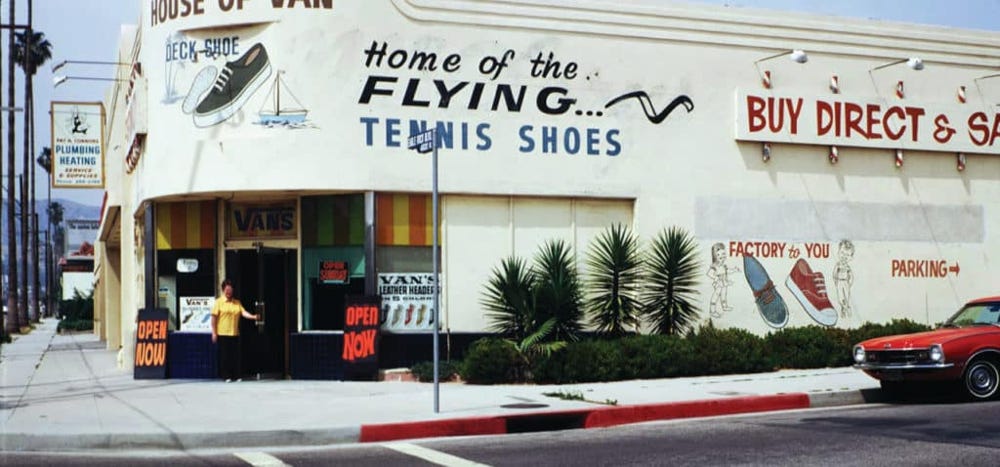
The first Vans store opened in 1966 as a small family business selling directly to the public. Paul Van Doren’s success, however, was never just about shoes—it was built on inner principles that guided every decision. For founders seeking wisdom on find their authentic journey, his stroy offers timeless lessons on shaping identity, resilience, decision-making, integrity, and also the art of letting go.
As a kid who grew up in 1990’s suburbia, to me the brand Vans is as timeless and permanent as Coke or Frigidaire. Even if Vans shoes haven’t changed much since the 1960’s, the brans has managed to stay cool and relevant, even as a large corporation. To me Vans is ultimate symbol for the broad DIY culture in which I grew up in: surf, snow skate, punk rock. That DIY ethic is still a big part of my identity today as a founder and a maker. I LOVE doing things on my own terms. and I guess Vans stayed cool because ot’s ok to get big if you do it on your own terms. That authentic DIY way of life is what Vans is ultimately about, and to me Paul Van Doren’s is the ultimate DIY godfather. DIY ethics are definitely a core aspect of any entrepreneur journey, and Van Doren has much to teach.
Vans cultural influence has been massive. Arguably, without Vans showing another way of building a brand, there likely wouldn’t be the same direct-to-consumer, streetwear, and DIY-centric brands.
Vans was a pioneer and it remains to this day this authentic, timeless product that easily appeals to pretty much all generations.
DTC Strategy: Control of production, distribution, and brand message like Warby Parker, Glossier.
Community-Driven: Letting customers shape the brand's direction like Patagonia, Supreme.
DIY + Anti-Corporate Identity: Selling independence, not just products like Liquid Death, Gymshark.
In their own words: Paul Van Doren
1. Identity & Self-Knowledge – “Be Yourself, Fully”
“I suddenly had the luxury of being 100% myself. Free to do things exactly as I saw fit and with abandon.”
Van Doren’s entrepreneurial awakening wasn’t about power or ambition—it was about autonomy. The moment he left a corporate job that no longer aligned with his values, he realized that founding a company was an act of self-definition. His insight speaks to the deep psychological shift many founders experience: entrepreneurship is less about building a business and more about becoming who you are.
2. Decision-Making – “Know the Line You Won’t Cross”
“There’s a line I’m not willing to step over that you clearly are.”
Van Doren had a deep sense of personal integrity and boundaries. His pivotal moment came when he watched his former boss humiliate himself for a major client—chasing pigeons in the Boston Common on demand from a drunk customer. That moment cemented a core principle: never let business strip you of dignity. He started Vans shortly after.
3. The Psychology of People – “We Are a People Company That Makes Shoes”
“We weren’t a shoe company, we were a people company that made shoes. That distinction may sound like nothing, but believe me, it’s everything.”
Van Doren saw business as a psychological ecosystem, not just a financial one. His success wasn’t from making shoes—it was from understanding people deeply: customers, employees, partners. This aligns with founder psychology: at the core of entrepreneurship is understanding human nature—your own, and others’. A founder’s real job is understanding what drives people—and helping them express their own voice, their own purpose.
4. Stress, Burnout & Emotional Endurance – “Grit is a State of Mind”
“I learned that what makes a successful entrepreneur is the same thing that makes a good skateboarder or surfer. You need grit and determination to get back up every time you’re knocked off the board.”
This is one of the best psychological metaphors for resilience in entrepreneurship. Van Doren understood that failure, setbacks, and stress are not obstacles—they are the default, the expectation.
5. Inner Philosophy – “What’s Right Is Right”
“I learned early on: what’s right is right, and what’s wrong is wrong. If you put thought into something and do what’s right every single time, you won’t be far off from doing the best you can—the best any of us can.”
This speaks to the moral compass of a founder—not in a naive sense, but in a practical, decision-making way. Founders face a constant pull toward shortcuts, compromises, and ethical gray areas. Choose the hard but right decision over the easy one. Integrity compounds over time.
6. Letting Go of Control – “You Can’t Own Everything”
“Without my kids, Vans wouldn’t exist. They, alongside their mother and me, got their hands dirty and worked for tacos.”
This is one of the deepest founder psychology insights—you don’t build alone. Many entrepreneurs obsess over control, but Van Doren had a different mindset: you must trust and rely on others, or you will break.
7. Facing Mortality – “We Are All We’ve Lost”
“I am also all of what I’ve lost.”
Van Doren reflected on outliving his wife, friends, business partners, and peers. This simple line is a sobering founder reality:
Your success won’t shield you from loss.
Every step forward leaves something behind.
What remains isn’t just what you built—but who you became in the process.