
Beauty is Social Infrastructure
In Part 1, we explored how your brain processes beauty and value through identical neural machinery. The orbitofrontal cortex can’t distinguish between “this is beautiful” and “this is valuable.” That explained individual behavior—why customers pay premiums for well-designed products, why aesthetic violations trigger threat responses, why founders with great taste build products people trust intuitively. We focused on the micro.
Today we explore the macro—how beauty operates at the scale of communities, cities, and companies.
Research points to collective sense of beauty as infrastructure, essential to human flourishing like roads, hospitals, and electrical grids. Infrastructure enables coordination at scale. Roads coordinate movement. Electrical grids coordinate energy. Communication networks coordinate information.
Beauty coordinates human cognition and social organization. It reduces physiological stress, freeing mental resources for complex tasks. It restores attention that demanding work depletes. And—most importantly—it synchronizes emotional states across groups, enabling collective action.
When we remove roads, society visibly breaks down. When we remove aesthetic infrastructure, society breaks down in diffuse ways we’ve learned to ignore. But research in the last 10-20 years clearly shows: failing to invest in beauty is tangibly costing us, and good design provides very high returns.
What Ugliness Costs Us
After World War II, cities in both Europe and US faced massive housing shortages. The response was guided by modernist ideology: function over form, efficiency over beauty, forgetting how brutalist and monotone buildings would feel for those living or working in them.
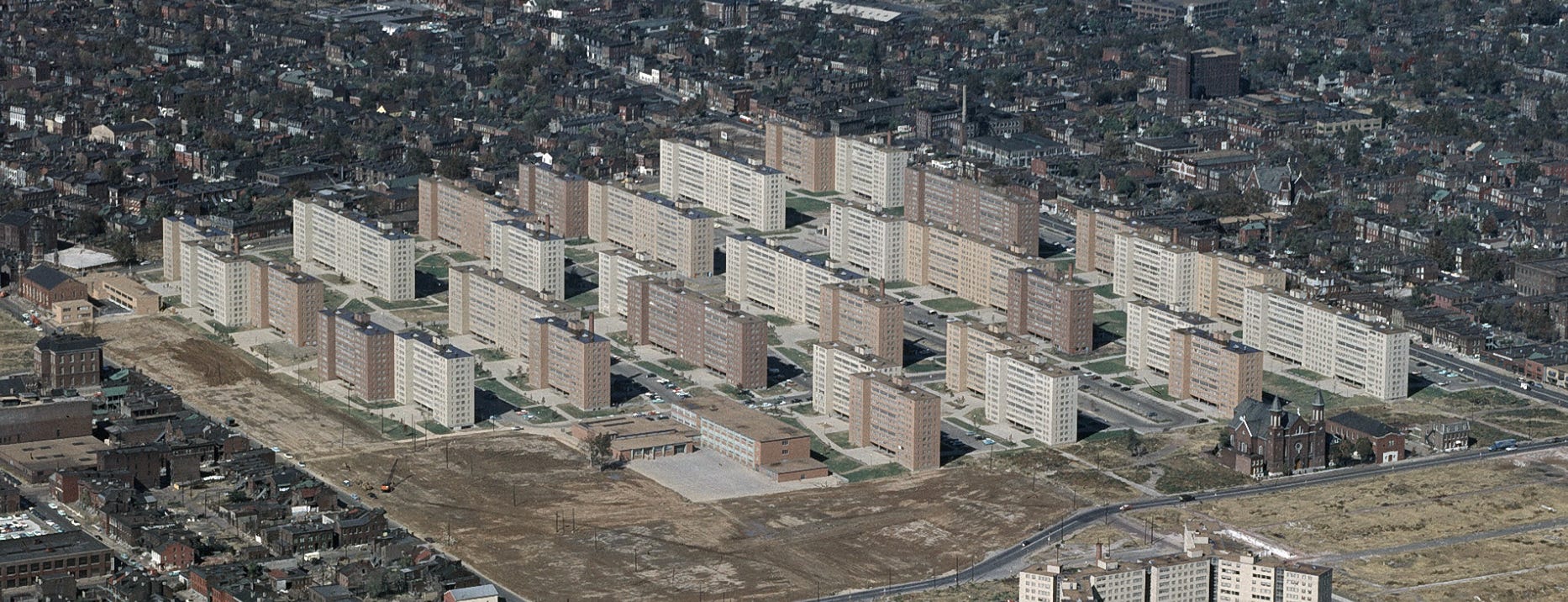
Take, for example, the Pruitt-Igoe in St. Louis— a 33 eleven-story towers complex.
Elevators only stopped on every third floor. Residents on floors without elevator access had to walk up or down a flight of stairs from the nearest stop. Long, interior hallways had no windows and were shared by dozens of apartments.
The idea for these design choices was to save construction costs and create more “efficient” vertical circulation. In practice, it meant long, unsupervised corridors and stairwells where crime flourished—and residents with groceries, strollers, or disabilities were stuck. Occupancy plummeted from 91% in 1957 to 35% by 1971. Crime made the complex unlivable. It was demolished in 1972, only 17 years after it was built.
Oscar Newman’s research compared Pruitt-Igoe with Carr Square Village across the street—a row-house development with identical demographics that remained fully occupied and trouble-free. The difference was design. Landings shared by two families stayed well-maintained; corridors shared by twenty became disasters; lobbies shared by 150 were a crime scene.
The validation came in Dayton, Ohio. When Five Oaks implemented Newman’s “defensible space”, design that allows residents to naturally monitor and take ownership of the areas around their homes, in the 1990s, overall crime fell 25%, violent crime fell 50%, traffic dropped 67%. These weren’t social programs. They were design decisions.
In the UK, similar large high rise complexes were erected post WW2. Alice Coleman’s research at King’s College London surveyed 4,050 blocks containing over 106,000 dwellings. Litter, graffiti, vandalism, and crime were exponentially more prevalent in high-rises than in streets of houses—far more than population density could explain. Robert Gifford’s meta-analysis of 99 studies found 55 documented negative psychological effects from high-rise living: higher rates of depression, neurosis, and social isolation. Children in high-rises developed fewer friends and showed less-developed social skills. All of this due to dubious design choices!
The post-war experiment proved that utilitarian design ideology—the belief that beauty is secondary—imposes massive costs in crime, mental illness, and community disintegration.
If you think good design is expensive, you should look at the cost of bad design - Ralf Speth, ex-CEO, Jaguar/Range Rover
Beauty delivers a collective ROI
Crime and Violence. In Chicago, researchers studied identical public housing buildings that differed only in vegetation. Buildings with trees and grass experienced 52% lower crime rates. In Philadelphia, greening vacant lots ($1,600 per lot) reduced gun violence 29%, returning over $200,000 in six years—a benefit-cost ratio between 47:1 and 125:1.
Man-made beauty produces similar effects. Philadelphia’s Mural Arts program tracked crime around 500+ streets with murals installed 2007-2023. Crime dropped 42%. Effects persisted up to seven years.
Mental Health. The Philadelphia greening study found depression symptoms decreased 41.5% among nearby residents, and notably 68% for residents below the poverty line. Colin Ellard’s research even measured skin conductance while participants walked past different facades. In front of Whole Foods’ blank glass facade, arousal and mood “took a dive.” Participants described it as “bland, monotonous, passionless” and quickened their pace to escape. One block away, at varied storefronts, they showed high excitement and reported feeling “lively and engaged.” The physiological signature of boredom appeared within seconds.
Healthcare. Roger Ulrich’s landmark study compared surgical patients with nature views versus brick wall views. Those viewing nature required 22% less pain medication, experienced hospital stays 8.5% shorter, and needed weaker analgesics. This single design decision—window orientation—could save $93 million annually across U.S. surgical recoveries.
Richard Taylor’s research found that fractal patterns—the self-similar structures in nature, traditional architecture, and great art—reduce stress by up to 60%. Traditional buildings contain these patterns through ornamentation. Modernist buildings systematically eliminate them.
Learning. Students in daylit classrooms learn 20-26% faster and score 7-18% higher on tests—the difference between a C and B student, achieved through window placement. Children show 2-3x greater sensitivity to environmental design than adults. ADHD symptoms significantly improve with brief nature exposure.
Productivity. Sacramento call center employees with vegetation views handled calls 6-7% faster, generating $2,990 annual gains from a $1,000 window investment—four-month payback, 299% first-year return. Retail stores adding skylights saw 40% sales increases.
Social Behavior. Charles Montgomery’s study assigned participants to pose as “lost tourists” near either active facades (high visual interest) or blank walls. Pedestrians near interesting storefronts were nearly five times more likely to help, and four times as many offered to physically escort the tourist. Beautiful environments transform how strangers treat each other.
The list of beneficial consequence good design, good taste and beauty offers goes on. Clearly there seems to be many ways beauty impacts our collective behaviours.
Why Groups Fail at Valuing Beauty
If beauty has such positive returns and ugliness costs us dearly, why isn’t everyone already investing in design? At the collective level, there are friction points that can hinder understanding and investing in good design.
Split incentives. The developer who saves on landscaping doesn’t pay for the crime increase. The building owner who skips skylights doesn’t suffer the productivity loss—the tenant’s employees do. The hospital administrator who approves cheaper windows doesn’t pay for extra pain medication.
Diffuse benefits. When a beautiful public space reduces stress and increases cohesion, benefits spread across thousands of people in ways no single entity can monetize. The value is real to user, but no one can profit from it.
Cost structure blindness. Research suggests 10% of absences trace to architecture lacking nature connection—costing $2,000-2,500 per employee annually. But because it shows up in HR metrics rather than facilities metrics, no one connects it to design.
As an entrepreneur, the failure of markets to properly price in the value of good taste and design is your opportunity.
The Collective Experience
Individual aesthetic experience activates reward circuitry. But shared aesthetic experience activates additional systems. When people experience beauty together, their brains show greater activation than experiencing identical stimuli alone. Choral singers report significantly higher wellbeing than solo singers—despite identical musical engagement. The difference isn’t the music. It’s the sharing.
This upends how we think about aesthetics. Western philosophy treats aesthetic judgment as individual contemplation. But neuroscience suggests beauty’s primary evolutionary function isn’t individual pleasure—it’s group coordination.
Anthropologists puzzled for decades over why all human societies invest extraordinary resources in aesthetic elaboration. Rituals, ceremonies, decorated spaces, elaborate costumes—massive expenditures with no obvious survival benefit. Why would evolution preserve such waste?
The returns come through social cohesion. Durkheim called it “collective effervescence”—the bonding that transforms isolated individuals into communities capable of collective action. Religious ceremonies worldwide represent humanity’s first “total works of art,” fusing song, dance, costume, and visual display into experiences that create shared identity.
Remove the aesthetic components from these rituals and they fail to produce cohesion. The beauty isn’t decorative. It’s the coordination mechanism.
This explains why some products become cultural phenomena while functionally equivalent competitors languish. Apple users don’t just prefer Apple products individually—they form communities around shared aesthetic values.
The design becomes a coordination mechanism, allowing users to identify fellow tribe members and reinforce each other’s commitment.
Products that nail aesthetics create synchronized experience among users—the neural equivalent of singing in harmony. Products with poor design prevent the collective states where communities form.
What about invisible (moral) beauty?
There’s a form of beauty with nothing to do with aesthetics—and it activates the same neural machinery.
Jonathan Haidt’s research on “moral elevation” documents what happens when we witness exceptional virtue: a stranger helping someone in need, an act of unexpected kindness. The response is physical—a warm, open feeling in the chest, attention turning outward, a desire to become better ourselves.
fMRI studies confirm that moral beauty and facial beauty activate overlapping regions in the orbitofrontal cortex—the same area that processes aesthetic and economic value. When we see someone do something beautiful, our brains process it through the same circuits as seeing something beautiful.
The behavioral effects are striking. In one study, participants who watched an uplifting video subsequently spent twice as long helping with a tedious task—40 minutes versus 20 minutes for controls. They weren’t imitating what they saw. They were “inspired in spirit, not in kind.”
Moral elevation functions as social coordination. When we witness virtue, we’re physically moved to propagate it. Beauty in one form generates beauty in another. The system is designed to spread.
The Weird Principle
One piece of research challenges the assumption that beauty must mean pleasant and immediately appealing. Studies on transformative experiences show that “unfamiliar and uncomfortable settings”, prove particularly effective for growth contexts. Cognitive dissonance appears necessary for genuine transformation.
Medical students in high-stakes simulations showed increased resilience through uncomfortable aesthetic contexts. The transformative potential originated from “disruption of pre-existing expectations triggering self-reflection.”
This suggests optimal aesthetic environments may need to challenge and provoke rather than merely soothe—particularly when the goal is growth rather than recovery.
The distinction matters for anyone building products intended to change how people think. Beauty that confirms expectations is pleasant but not transformative. Beauty that violates expectations in the right ways forces the cognitive work that produces lasting change. That’s why you may find something weird at first before you come to appreciate the beauty.
Entrepreneurial Implications
Your aesthetic choices determine what kind of community forms, who your users are, whether they bond or remain isolated individuals who happen to use the same tool, and whether they become advocates who recruit others. Good design choices are applicable in all decisions, small and large. Hone your taste, learn the timeless principles behind good design, and value taste as what it is: a transformative, meaningful, powerful and worthy endeavour.
The value of good taste can be hard to measure. Don’t mistake lack of numbers for lack of value.
If you view aesthetics as optional, you’ll optimize for features, price, and efficiency—and consistently underperform on dimensions you don’t know you’re competing on.
The companies that do best understand beauty as infrastructure, as coordination system. They invest in aesthetic quality the same way they invest in engineering quality.
The collective implications on beauty takes us to our part 3 - the final part. We will explore why and how to build great taste as a founder.
Happy Sunday ✌🏼