
Who isn’t feeling totally overwhelmed lately? I had dinner with founder friends last week. We all shared the same feeling that focus is a losing game. And it seems to be getting worse each year.
Despite countless productivity books and frameworks, focus in this day and age remains elusive for most founders. I'm starting to think focus isn't about knowledge—it has deeper roots than our conscious decisions.
As a founder with ADHD, like many of us, focus is a daily challenge. I tend to struggle to stick to a single task for long, and I want to pursue too many exciting things. Prevalence of ADHD is around 29% for founders vs. 5% for the general population. Those with ADHD were significantly more likely to start multiple ventures, especially those with hyperactivity/impulsivity traits.
The irony: the people who need focus skills most are those who struggle with it most.
Grief as an unexpected teacher
I noticed something recently in my life after a pretty challenging 18 months. My family and I grieved the loss of 3 pregnancies, along with a series of other unexpected setbacks that felt like major losses initially. Such is life, a cycle of gains and loss, births and death. It's never what we imagined.
Grieving made me ruthless about saying no—about doing only what I truly value. I stopped fearing the pain of loss and change, preferring to accept reality rather than exist in avoidance.
When you focus by saying no to something, you experience a mini-death: you say goodbye to a relationship, an idea, an expectation somewhere down in the future. It sucks to grieve. But actively grieving makes room for you to grow into your higher potential - even if all you feel right now is the pain of loss. The void created usually gets filled with more of the better stuff. This is the cycle of gain and loss at work.
Why less is more
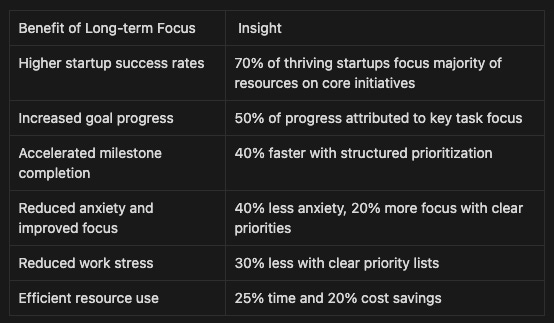
Well-researched principles help with long-term prioritization: delaying gratification, clarifying end goals, asserting boundaries, regular vision reviews, optimal resource allocation.
These frameworks help—but they're insufficient. The emotional drivers that hinder focus overpower conscious thought. Focus isn't intellectual, otherwise you'd have solved it already. This connects to your ability to willingly grieve your "no's"—working with pain to create space for a better future.
"Focus means saying no to something with every bone in your body screaming yes." - Steve Jobs
Entropy is the default state
The universe's natural state is expansion. Without active trimming, you accumulate more projects, relationships, demands, weight. Bloat is everywhere. Without care, your life becomes bottlenecked.
The Science of Bloat

You can and should fight back. Simplifying your life creates valuable constraints against the universe's expansive nature. Fighting entropy means working out, eating well, investing in relationships that lift you up, finally accepting you can do anything—but not everything.
Focus is intentional removal
You as a founder are the best person on your team to remove and simplify. Like a sculptor chiseling non-essential parts to create a real work of art. Most likely everyone on your team wants to do more than can deliver in the short term. Managers want to prove their value and build a reputation by doing more, going harder, fighting longer. Rarely do managers want to kill projects early. They usually don't have the incentives to do less - and grieving sucks.
You have the strongest incentive to do what's needed for your team to win. You're the counterforce to organizational bloat. You owe your team the discipline to stop lesser things, making room for their higher potential.
Focus isn't just about hard tradeoffs—that frame feels heavy. Instead, frame focus as devotion to your higher potential. Focus is an emotional skill disguised as an intellectual one. Until you learn to grieve well, to sit with the pain of saying no, your focus will remain fragmented. The path forward isn't another productivity system—it's developing the emotional capacity to stay on your authentic path.
"I've come to believe that focus is a form of spiritual discipline. It's not about narrowing. It's about honouring." - unknown founder
Have a nice week-end 🌕 ✌🏼
Gui
Footnotes
Rajah, N., Bamiatzi, V., and Williams, N. (2021). ADHD prevalence: 29% in entrepreneurs vs 5% general population. Journal of Business Venturing Insights.
McKinsey & Company: Companies actively reallocating resources outperform static competitors by 40% over 15 years. Source: McKinsey Research
McKinsey & Company (2017): Specialty chemicals company reduced projects 40%, budget only 16%. Source: Project Resource Allocation
CB Insights: Poor product development ranks among top startup failure reasons. Source: Startup Failure Analysis
Goal achievement research: Only 30% of the 20% who set long-term goals achieve them. Source: Psychology of Long-Term Goals
McKinsey: CEOs who don't actively reallocate resources are significantly more likely to be removed from position.
MassLight: Startups with defined product development strategies attract more investors. Source: Product Development Success