
Your Goals Define Who You Become
No dream is as great as the person you might become by remaining true to it. —Dee Hock, founder of Visa
What to focus on is a hard question all founders grapple with. After all, entrepreneurship is an open-ended adventure with no fixed rules. The only rules that apply to you are the ones you decide work for you.
With no explicit rules, and with the definition of success being entirely subjective, the role of the founder is, by definition, ambiguous, complex, and demanding. It's hard to decide what to prioritize when there seems to be so many important ways to use your time. As we've seen in the last section, focus, especially intense focus, is such a critical skill for founders to reach full potential.
Founders who hold extreme focus by doing just one main thing tend to have the most impact. This is a trait I've noticed among the best founders in history.* They are able to remove all distractions. But perhaps even more powerful, this level of focus and clarity becomes a cultural norm within the company. Founders with mixed priorities end up leading a confused team building the wrong things. As HP co-founder David Packard elegantly put it, "More businesses die from indigestion than starvation."†
Steve Jobs was focused on one thing: great design. Unsurprisingly, Apple has a streamlined and integrated product suite. Jeff Bezos focused on customer obsession; Amazon became known for innovating on behalf of customers, steadily improving the experience throughout the years. Google creators Larry Page and Sergey Brin had an extreme focus on organizing the internet and making it accessible. Beyond its search engine, Google has pioneered seemingly disjointed products, but they all have the same focus: Maps, Books, Analytics, and Translate all help organize online data and make it usable.
An organization's focus rests on its leader's ability to focus. —Paul Van Doren
Vans founder Paul Van Doren exemplifies this kind of focused leadership. "What I do better than anything else is cut out distractions," he wrote in his memoir, Authentic. "If a system isn't working efficiently, I can see where it's jammed, eliminate the problem, and find a way to keep everything moving forward. Everyone has something they naturally do better than anyone else—this happens to be mine, and I was lucky enough to have the opportunity to leverage it for myself and others."*
Goals are about more than making your focus explicit. To me, the higher reason for having goals is not to be productive or successful, but to decide who you want to be, and what you really value. What you focus on consistently through the years will define your impact, your character, and ultimately your legacy.
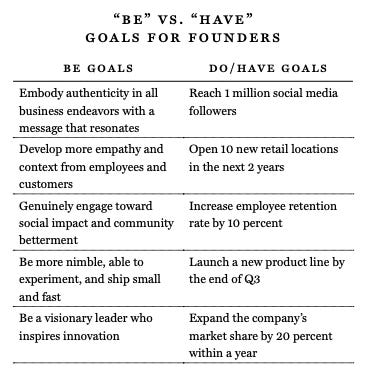
In setting goals, most people think of what to do or what they want to have. Few people consider the person they become in pursuing a goal. Goals are typically focused on changing something; therefore, it seems sensible for you to change along the way. The best goals center on becoming, not doing or having. That's because the most rewarding aspects of reaching your goal lie in your chance at improving, each step of the way.
Some goals will bring you permanent value, while others will only bring you ephemeral satisfaction. "Be" goals stay with you, while "do" and "have" goals are temporary. For example, if you want to improve your health, you can choose to become a healthier person (be) or to lose weight (do). Most people focus on losing weight without a change in their identity because it seems the simpler or faster approach; then they end up gaining back the weight they lose. A "be" goal is better because once the weight has been lost, the change in habits and identity that gave you the results remains in place.
"Be" vs. "have" goals for founders
The Tale of the Monk and the Crystal Mountain
A monk heard of a legendary Crystal Mountain at the far end of a vast desert, full of jewels. Believing he could use the wealth to fund monasteries and help the needy, he set off on a long journey. He faced burning sun, freezing nights, and sandstorms, helping other travelers in need along the way.
Eventually, the monk reached Crystal Mountain, its beauty beyond imagination. As he meditated, he realized his true treasure was not the crystals but the inner strength, patience, and compassion he gained on his journey.
Taking a single crystal as a token, the monk returned to teach others about the wealth found in resilience, kindness, compassion, and self-discovery.
This tale shows transformation in the pursuit of goals. Once the monk reached Crystal Mountain, he discovered that the reward was not the wealth he sought, but the inner growth he experienced along the way. He understood that the meaning of the goal lies in the personal transformation that the journey brings.
It's hard to know why you want what you want
Given our mimetic nature, it is essential as a founder to be able to discern whether your goals are coming from within or from outside yourself. Without introspection it is easy to inadvertently adopt others' beliefs or desires. That's why knowing why you want what you want is the best way to remain true to yourself.
How do you know if your goals are truly authentic and intrinsic? For me, looking at them through the lens of time travel greatly helps me focus on becoming who I really want to become, with confidence and clarity, regardless of the noise that is external reality. Following are examples of questions you can ask yourself to frame your goals with a time travel perspective.
Will this goal matter in 10 years? Discard goals without a clear picture of what changes will look like down the line. Most things you are concerned with today won't matter when you look back.
What would your 80-year-old self think? How might you feel looking back? Will you regret more what you did or what you did not do?
What would your 15-year-old self think? Would your young self be happy, disappointed, or surprised with your adult choices?
Being ambitious, many founders try to manifest the most extreme version of their goals. But making a goal bigger isn't necessarily better. Size can distract from what truly matters, like who you are and who you will become by pursuing your goals. If size means you can help more people or make a bigger contribution to your mission, and your mission is authentic and for the greater good, then by all means maximize your goals. But size for its own sake is not a valid goal.
A clear view of who you want to become lets you embrace the "less-is-more" mantra. By doing less, you do what you do, only better. By wanting less, you give life more flavour and more presence for the fewer things you do really want and value. Check your desires. Desiring less and desiring better lead to a peaceful mind—and perhaps clearer goals.
Goals shouldn't feel like an impossible burden that makes your life hard; they should make you feel more alive by giving you focus and energy. All worthy goals take hard work and sacrifice, but being consistently depressed or anxious about reaching your goal is a sign you might be reaching for the wrong things in the wrong way. Feeling burdened by your goals is a nudge to consider other goals that will make you feel more alive and allow you to fully engage in the present as you pursue them.
The Tale of the Fisherman and the Businessman
An executive of a large, public company was on (a rare) vacation in a small coastal village when he saw a fisherman docking his boat. Inside the boat were several large fish. Impressed, the businessman asked the fisherman how long it took to catch them. "Only a little while."
The businessman then asked why he didn't stay out longer to catch more fish. The fisherman explained that he had enough to support his family's immediate needs. The businessman pressed on, asking what the fisherman did with the rest of his time. The fisherman said, "I sleep late, fish a little, play with my children, take siestas with my wife, and stroll into the village each evening where I sip wine and play guitar with my friends. I have a full and busy life."
The executive scoffed and offered a business plan: "I built and sold companies for a lot of money, and I could help you. You should spend more time fishing, and with the proceeds buy a bigger boat. With the proceeds from the bigger boat, you could buy several boats, and eventually you would have a whole fleet of fishing boats. Instead of selling your catch to a middleman, you could sell directly to the processor, eventually opening your own cannery. You would control the product, processing, and distribution. You would need to leave this small coastal fishing village and move to a bigger village, then the next bigger village, and eventually the big city, where you will run your expanding enterprise."
"How long will this all take?" the fisherman asked.
"Fifteen to twenty years. Twenty-five tops."
"And then what?"
The executive laughed and said, "That's the best part. When the time is right, you would announce an IPO and sell your company stock to the public and become very rich. You would make billions."
"Billions? Then what?"
"Then you would retire," the businessman said. "Move to a small coastal fishing village where you would sleep late, fish a little, play with your kids, take siestas with your wife, and stroll to the village in the evenings where you could sip wine and play your guitar with your friends."
Big goals mean little if they aren't aligned with what you value most. The person you become in pursuing your goals is more important than whether you succeed in achieving the goals. Great goals can certainly lead you to become a great person. But although goals exist in the future, they should help you be a more fulfilled and upgraded version of yourself today and along the way.
The downside of your goals
Beware: While goals can motivate you to push yourself to reach a greater potential, they can also, paradoxically, make you feel inadequate. Embedded in goals is the implicit notion that things can, and should, be improved. Goals expose a gap in your reality; they are inherently a desire to change something that comes from the observation that things are not as good as they could be.
Goals can make you greedy. Perhaps the biggest downside of chasing your goals is how difficult it is to stop the goalpost from moving after you reach the initial target. While humans innately seek to push our limits, a sense of having and being enough is the highest form of wealth one can have. That feeling of contentment can only come from within.
The wealthiest person is a pauper at times / compared to the man with a satisfied mind. —Johnny Cash, "Satisfied Mind"
Lastly, fixating on your goals can become a form of escapism, a way to bypass the present for a brighter (yet still imaginary) future. You are fooling yourself if you think you need to reach your goals to allow yourself to feel good about yourself. Many founders, including me, are naturally future oriented instead of present oriented.* Future orientation is great for planning and achieving, a great mindset for achievement—but not so great for contentment. Don't use goals to escape from a today you wish was entirely different. Create goals that start with your current reality, and build with it.
Choose goals that minimize future regrets
Fast-forward to the end of your life. What will you think as you look back on your entire journey? Consider the regrets your future self may face in your final days.
In her book The Top Five Regrets of the Dying: A Life Transformed by the Dearly Departing, Bronnie Ware writes about the regrets dying patients reported during her time working in palliative care. According to Ware, the top five regrets people had on their deathbeds were:
I wish I had the courage to live a life that was true to myself, not the life others expected of me.
I wish I had not worked so hard.
I wish I had the courage to express my feelings.
I wish I had stayed in touch with my friends.
I wish I had let myself be happier.*
This perspective cuts to the core of what life is really about. There is no mention of money, fame, status, or power. None of that matters in the end. No one else can evaluate your goals. Goals are a very personal thing. You don't have to share them with anyone else. In fact, it might be a great idea to not tell anyone. When you hold these truths privately, it is easier to stay true to yourself. It is also easier to change them.
But doesn't discarding goals mean you're a quitter? Shouldn't you tell others your goals so they can keep you accountable? Here lies another conundrum founders encounter: the choice of when to persevere and when to pick another goal. There are valid arguments on either side for making your goals public or private. In any case, the key when changing goals is replacing them with improved goals, not abandoning them outright just because they are hard. Change goals only to upgrade them.
Having your own inner scorecard takes courage. It takes courage to trust your inner voice and take unpopular action. What others think of you is not up to you. It is also none of your business. A life well lived includes a healthy distance from what other people think. When it comes to defining your own life, you are the coach, the player, and the referee. You're also the post-game commentator, the season-ticket holder, the cheerleader, and the fluffy mascot.
Goals start and end with you.
I always wanted to be somebody, but now I realize I should have been more specific. —Lily Tomlin
Have a nice week end ✌🏼🌕
Gui
p.s. This post is a free chapter from Tao of Founders. Please share your feedback!
Footnotes
*Sadly, extreme focus can become neglect when taken to an extreme; unsurprisingly, many celebrity founders have dysfunctional personal lives. The real heroes are the ones who manage to build a great business AND a house full of love.
†Packard, The HP Way.
*Van Doren, Authentic, xiii.
*Derek Sivers discusses this idea in his post "Are You Present-Focused or Future-Focused?": https://sive.rs/time.
*See more on her blog: https://bronnieware.com/blog/regrets-of-the-dying.